Smart Ways to Organize Garage Cabinets for a Family With Different Needs & Lifestyles
Every family member who uses the garage has different habits, different storage needs, and a different idea of what organized actually looks like. I've seen garages where one person's perfectly arranged garage cabinets become another person's obstacle course within a week. Without a system that accounts for everyone from the start, the chaos has a way of creeping back in no matter how many times the garage gets cleaned out.
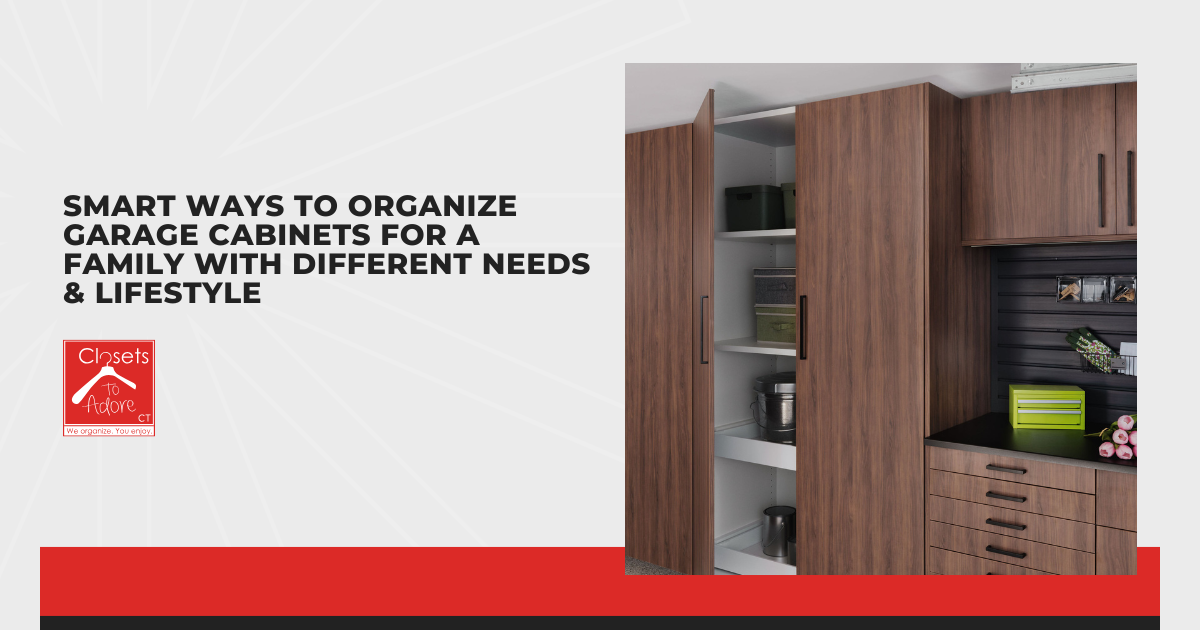
Garage cabinets are only as effective as the organization system behind them. A parent needs quick access to tools, a kid needs to grab a bike helmet without asking for help, and a teenager's gear seems to multiply every season. Designing a cabinet layout that actually works for all of them takes more thought than most families expect, but it's entirely doable with the right approach.
Before diving in, here are the key strategies that will help you turn your garage cabinets into a system that actually works for every member of the family.
- Start with a family audit
- Create dedicated zones for each family member
- Prioritize accessibility based on age and frequency of use
- Separate hazardous items from family-friendly storage
- Use labeling and color coding to keep everyone on the same page
- Plan for seasonal storage needs
- Make room for growth and change
Each one of these strategies builds on the last, so it's worth reading through all of them before making any decisions about your cabinet layout.
Start With a Family Audit
Before a single cabinet is moved or a label is printed, it helps to take stock of who actually uses the garage and what they're using it for. Most families are surprised to discover just how many different activities, hobbies, and storage needs are competing for the same space. A quick family audit doesn't have to be formal, but it does need to be honest.
Walking through the garage with every family member and asking them what they store, what they access regularly, and what frustrates them most about the current setup is a revealing exercise. Kids will tell you they can never find their sports gear. Parents will point to tools buried under seasonal decorations. Teenagers will mention the lack of dedicated space for their equipment, and those specific complaints become the clearest guide for what the new system needs to address.
The audit should produce a clear picture of three things: what's being stored, who needs access to it, and how often. From there, decisions about cabinet depth, shelf height, and zone placement become much easier to make with confidence. Most garage organization attempts don't stick precisely because this step gets skipped.
Create Dedicated Zones for Each Family Member
Speed in the morning often comes down to predictability. When every item has a designated location, there’s no hesitation about where to look or where to return it later. Custom closet systems create structure by dividing clothing, shoes, and accessories into clearly defined zones. That structure removes the guesswork that slows mornings down.
Dedicated shoe shelves prevent pairs from scattering across the floor. Drawer inserts keep smaller items separated so you’re not digging through tangled accessories. Hanging sections grouped by category make it easier to compare outfits without shifting everything around. Clear storage zones reduce the visual clutter that can quietly add stress before the day even begins.
Consistency plays a major role in maintaining that efficiency. Returning items to the same location each day keeps the layout stable and predictable. Nothing drifts into random corners because every piece has a clear home. A closet that maintains order naturally supports a faster, more streamlined routine.
Easy Access to Everyday Items
Giving every family member their own designated cabinet space is the single most effective way to keep a shared garage from descending into chaos. When storage is communal and undefined, things get mixed together quickly and nobody feels responsible for keeping any particular area tidy. Assigning specific zones removes that ambiguity and gives everyone a clear sense of ownership over their space. It's a small structural change that makes a big difference in how the whole system holds up.
I've found that families who treat cabinet zones the same way they treat rooms in the house tend to maintain their garage organization far longer than those who don't. Dad's tools stay in dad's section, the kids' sports gear has its own cabinet, and mom's gardening supplies don't end up mixed in with the automotive equipment. The physical separation of these categories by person makes a significant difference in how well the system holds up over time.
Zone assignments should be based on frequency of use and the size of each person's storage needs. A teenager with a lot of gear needs more room than a young child with a few sports items. Dividing space based on real storage needs rather than splitting it equally is what makes the system feel fair and functional for the whole family.
Prioritize Accessibility Based on Age and Frequency of Use
Cabinet placement should reflect how often something gets used and who needs to reach it. Items grabbed daily or weekly belong at eye level or within easy reach, while things that only come out a few times a year can live higher up or further back. Treating all storage as equal ends up being inconvenient for everyone in the household. A little thought put into placement upfront saves a lot of frustration later.
Children's items deserve particular attention when thinking through cabinet placement. A young child who can't reach their bike helmet without asking for help will either stop putting it back or stop asking altogether. Kids are far more likely to put things back where they belong when they can reach them without help.
Adults tend to underestimate how much time gets wasted searching for things stored in the wrong place. Tools used weekly shouldn't be buried behind seasonal equipment that only comes out twice a year. Cabinet placement decisions become much clearer once you know how often each item actually gets used. Frequency of use is one of the simplest and most overlooked factors in garage organization.
Separate Hazardous Items From Family-Friendly Storage
A garage that's used by the whole family needs to account for the fact that not everything stored in it is safe for everyone to access. Pesticides, fertilizers, automotive fluids, sharp tools, and power equipment all pose real risks to young children who don't yet understand the dangers. A dedicated, secure section of the cabinet system for these items isn't optional in a household with kids. It's a non-negotiable part of designing a family-friendly garage.
Locked cabinets are worth considering for anything that could cause harm if handled incorrectly. Many garage cabinet systems offer locking doors as either a standard feature or an upgrade, and for families with young children, it's an upgrade worth prioritizing. A lock removes the risk entirely rather than relying on kids to know better.
Hazardous storage areas should be clearly labeled even when cabinets are locked, as it reinforces awareness for older children and teenagers who do have access. Dangerous items grouped together in one dedicated section are also easier to do a quick visual check on. Peace of mind is a big part of what a family-friendly garage organization system should deliver. Nothing is more unsettling than not being sure whether everything dangerous is properly put away.
Use Labeling and Color Coding to Keep Everyone on the Same Page
Garage cabinets without clear labeling rely entirely on memory, and in a busy household, that's rarely reliable. Labels take the guesswork out of where things go. Less time spent searching means fewer excuses for putting things back in the wrong place, and fewer arguments about who left what where.
Color coding adds another layer that's particularly useful in households with young children who can't read yet. Assigning a specific color to each family member's zone makes it immediately obvious whose space is whose. I've seen this work remarkably well in garages where multiple kids share the same storage area. It turns the organization into something even the youngest family members can understand and follow without being told.
Labels and color coding only work if the whole family commits to the system from the start. Involving kids in choosing their colors and labeling their own sections gives them a sense of ownership that makes them far more likely to respect it. Adults are no different in that regard. Buy-in from everyone in the household is what makes the difference between a system that lasts and one that falls apart within a month.
Plan for Seasonal Storage Needs
Garage storage needs shift dramatically throughout the year, and a family's cabinet layout needs to account for that from the start. Snow blowers, sleds, and winter gear compete for the same space as lawn equipment, bikes, and outdoor toys during warmer months. Without a plan for rotating seasonal items in and out, the garage tends to become a dumping ground for whatever season just ended. A little forethought at the planning stage prevents a lot of chaos later.
Dedicating a specific section of the garage cabinets to seasonal storage makes the rotation process far less disruptive. Clear bins with labeled contents stored on higher shelves work particularly well for items that only come out a few times a year. Having a designated home for seasonal items means rotation at the start of a new season becomes a straightforward task rather than a full reorganization project. Labels on the bins themselves speed up the process even further.
Where seasonal items live within the cabinet layout matters just as much as having a dedicated space for them. Winter gear grabbed multiple times a week during colder months shouldn't be buried behind items used far less often. Placement adjustments at the start of each season keep the garage cabinets functional and frustration-free year round.
Make Room for Growth and Change
A family's storage needs rarely stay the same for long. Kids grow out of sports and pick up new hobbies, teenagers start driving and need space for automotive supplies, and parents accumulate tools and equipment over time. Garage cabinets that can't adapt to those changes end up feeling cramped and outdated long before they should. Planning for flexibility from the start is what separates a cabinet layout that ages with the family from one that works against it.
Modular garage cabinets are worth considering specifically because they can be reconfigured as needs change. Adding shelves, swapping out drawer units, or expanding into unused wall space are all options that become available when the layout wasn't designed as a fixed, permanent system. Flexibility built into the original layout is far cheaper than a full reinstallation down the road.
Revisiting the cabinet layout once a year as a family is a habit worth building into the routine. Storage needs that made sense two years ago may no longer reflect how the garage actually gets used today. A quick annual review keeps the garage cabinets aligned with where the family is now rather than where it was when the cabinets were first installed. Small adjustments made regularly are far easier to manage than a complete overhaul every few years.
Conclusion
Shared garages work best when the organization system behind them was built with every family member in mind. Without that foundation, even the most expensive garage cabinets will fall into disarray within a few months. The strategies covered here aren't complicated, but they do require honest input from everyone in the household before a single cabinet gets moved. Families that commit to the process end up with a garage that genuinely works for all of them, not just the person who organized it last.
Recent Posts